
Feed People
A journey through the Kumaon hills, Kainchi Dham and Gaya — and the threshold the model crossed on the day after I left
Nemdhari LLC · October 2026 · covers the three weeks to the 9 October close
I left on the 24th of September. By the time I next opened the gauge it was the 9th of October.
Three Sundays went by with no letter. I was in India with my family, then up in the hills, and I did not think about the ten-year once.
I needed it more than I knew.
While I was away the model crossed a line it had been waiting months for, and did nothing about it. I'll come to that. First, the three places.
Mukteshwar
The Kumaon hills sit in Uttarakhand, in the first serious rise of the Himalaya — foothills only in the sense that something much larger stands behind them. Mukteshwar is a ridge town about fifty kilometres beyond Nainital, at around seven and a half thousand feet, under dense deodar. It takes its name from Mukteshwar Dham, a Shiva temple of perhaps three hundred and fifty years standing on the highest point of the ridge, with a white marble lingam inside. Behind the temple the ground simply stops: a rock face called Chauli ki Jali, and then air.
I went for three days because I love these hills, which is not a sophisticated reason.
The thing about that altitude is what happens before anyone is awake. The valley fills overnight and you come out to find the cloud sitting below you, flat as a floor, with the far ridges standing out of it. Later it goes and the day becomes an ordinary bright day. But for a while there is a horizon that behaves like a sea, and you understand why people built on these ridges and not on the perfectly pleasant land below.
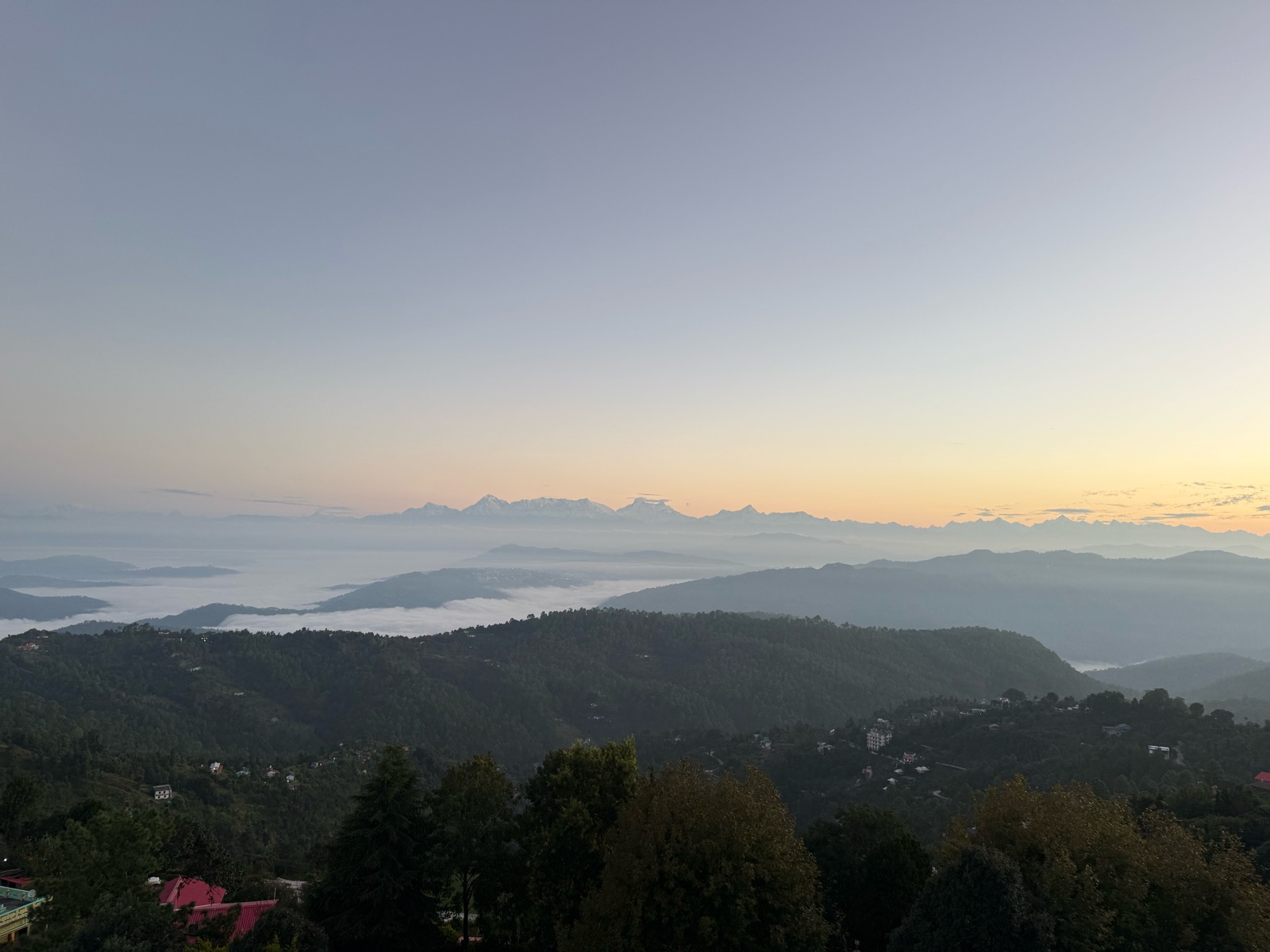
चाय की चुस्की, हिमालय का सुनहरा नज़ारा,
मुक्तेश्वर की भोर में सूरज का प्यारा इशारा।
मन को मिलता है ऐसा सुकून, जैसे समय ठहर जाए,
"Be Here Now" की अनुभूति में हर पल खिल जाए।
A sip of chai, the Himalaya laid out in gold; in Mukteshwar's first light, the sun's small gesture of welcome. The mind settles into such stillness that time itself seems to stop — and in that being-here-now, every moment opens.
I did nothing there of any consequence. That was the point. The deodars do not care about the ten-year yield.
Kainchi Dham
Down from the ridge, on the road from Nainital to Almora, about nine kilometres past Bhowali, two hillsides cross each other like a pair of open blades. Kainchi means scissors. The ashram in that narrow valley, on the bank of the Shipra, is Kainchi Dham.
It was established in 1964 by Neem Karoli Baba — Maharaj-ji to those who follow him — on land a local man gave for the purpose; the Hanuman temple at its centre was consecrated that June. It became his principal ashram for the rest of his life. In September 1973 he left his body — mahasamadhi, the conscious departure the tradition holds apart from ordinary dying.
Readers outside India have most likely met this valley without knowing it. In 1967 a Harvard psychologist named Richard Alpert came to these hills and met Maharaj-ji, who gave him the name Ram Dass — servant of God. In 1971 he published Be Here Now, which sold north of two million copies and became the doorway through which a generation of Westerners walked into Eastern thought.
Steve Jobs followed that book to this valley in 1974, arriving a year after Maharaj-ji left his body. Mark Zuckerberg came decades later on Jobs's advice, during Facebook's difficult early years. Julia Roberts has said a photograph of Maharaj-ji was what drew her to Hinduism — "I did not know who he was or what he was about but felt a very strong interest." None of the three ever met the man, which tells you something about the reach of a small ashram in a narrow valley.
That is where the phrase in my verse comes from. It is not an import into these hills. It is from them, and I was on my way to the valley it came out of.
So: Kainchi Dham, and something I am still turning over.
There was a queue, as there always is, in real heat and real sun. And I noticed that I did not want it to move. I wanted it to move very slowly, or not at all, so that I could stay longer — so that I could be in that place, in that moment, for as long as the line would allow.
My working days are organised almost entirely around wanting things to happen faster. Faster data, the next print, the next close. To stand in the heat and hope the line would not advance was the exact inversion of that, and it did not feel like patience. It felt like arriving. I was at peace there in spite of the heat, not by overcoming it.
जैसे समय ठहर जाए — as if time stopped. The line I had written about a sunrise turned out to describe a queue.
Gaya
Then east and down, out of the hills entirely, to Gaya in Bihar.
Gaya is where Hindus go to perform Shraadh — the rites owed to the dead. Of all the places it can be done, this is the one the tradition singles out: the city is called Gaya Ji, and the texts hold that rites performed there release generations of forebears at once. Pilgrims make offerings of rice-flour at the Vishnupad temple, which is built around what is held to be Vishnu's footprint set in black basalt, and on the bank of the Falgu river.
The Falgu is worth a sentence of its own. For most of the year it runs beneath its own sand rather than over it, so pilgrims dig down through the riverbed to reach the water they need. A river you have to excavate in order to use is a strange and fitting thing to find at a place of ancestral rites.
Pitru Paksha is the fortnight of the lunar calendar set aside for the ancestors — the pitri gan, taken collectively rather than one by one. I went on Navami, its ninth day, and performed Gayaji Shraadh for mine.
I will not pretend to a theology I am not qualified to explain. I will say what struck me as a person who thinks professionally about time horizons. Shraadh is an obligation that runs backwards — discharged by the living, owed to the dead, and discharged in the expectation that someone will one day do the same for you. It is a horizon measured in generations, kept by people who will never see the settlement.
I spend my days arguing that investors cannot think past the next quarter. It was useful to kneel inside a tradition that has never thought in quarters at all.
Ann Daan
The journey ended by feeding five hundred villagers.
Ann Daan is the giving of food. The scriptures rank it first among all forms of giving — annadaan mahadaan, the greatest of the gifts — on the straightforward ground that food is the one gift that satisfies completely, because it sustains the life that receives it. It is not an addendum to the rites at Gaya either; feeding the living is part of how the dead are honoured. You discharge an obligation to those who came before by turning round and feeding those who are here.
And there is a plainer reason it belonged at the end of this particular road.
Someone once asked Neem Karoli Baba how a person becomes enlightened. His answer was two words: feed people. His instruction to those around him came in four — love everyone, serve everyone, feed everyone, remember God — and the feeding was never figurative. At the great feasts at Kainchi he watched the serving lines himself and would not have anyone miss out. One old woman, fed there, is remembered for saying that nobody had ever fed her like that before.
So a journey that started in his hills, and borrowed its guiding phrase from his most famous disciple, ended by doing the thing he actually told people to do. Peaceful, beautiful, spiritual — and then five hundred plates. That is the whole of it, and it is why there was no letter.
And then the return
I came home with the jet lag still on me and put it to use. Tea at four in the morning, the gauge open, expecting to find I had missed something.
I had not. The S&P closed Friday at 7,811.54, about 2% above where it stood when this letter last appeared. The regime still reads GOLDILOCKS. Conviction sits at −0.00, and that is not a rounding joke: flat to three decimals. September's month-end finished the move out of Reflation and October has kept it there. Nothing broke. No guardrail armed.
Three weeks away and the weather had not changed. There is a particular flavour of anticlimax in that, and I recommend it.
Two things did change while the page was dark, and only one of them showed up in the index.
| 18 Sep | 9 Oct | ||
|---|---|---|---|
| High-yield spread | 2.68% | 3.15% | +47bp |
| Baa spread | 1.40% | 1.48% | +8bp |
| 10-year Treasury | 5.11% | 5.24% | +13bp |
| 10-year breakeven | 2.33% | 2.33% | unchanged |
| Equal- vs cap-weight, 12-month | −3.22% | −0.18% | narrowing reversed |
Credit
High-yield spreads widened forty-seven basis points, 2.68% to 3.15%. The VIX stayed under fifteen the whole time. Repo never left the comfortable side of the floor.
That combination is odd, and it is the part I keep going back to. Credit usually widens because something drags it wider: a funding scare, an equity shock, something you can point at on a chart. This widened on its own, quietly, with everything around it calm. When it happens that way it is usually about the borrowers rather than the plumbing. The investment-grade Baa spread moved eight basis points over the same stretch. Eight against forty-seven. Whatever this is, it is happening at the weaker end and not everywhere.
Credit is the closest of our three fast-cut legs to its trigger. It was in September too, and it is closer now. It has not armed. I am watching it rather than acting on it, and I would rather say that plainly than dress it up as a call.
The long end
The ten-year closed at 5.24%, the thirty-year at 5.60%.
Here is the bit that matters, and it is the bit most commentary skates over. Ten-year breakevens did not move. Still 2.33%. So none of this is the market changing its mind about inflation. All of it is real yields. The price of money went up; the expected path of prices did not. Those are different things and they get run together constantly.
Gold fell 6.8% through September and has won some of it back. Long Treasuries fell 5.4% and have not.
Which finally brought a threshold into range.
The threshold
We size long bonds on one question: how far is the ten-year above fair value? Fair value here is the average of the Bund yield and seven-year nominal GDP growth, a rule we take from Gundlach. Under a quarter-point premium we own no duration at all. At three-quarters of a point we own the lot. Fair value is 4.82%, the ten-year is 5.24%, so the gap is +0.42.
Here is that gap across the three weeks I was away.
| Week ending | Gap | Gate |
|---|---|---|
| 11 Sep | 0.139 | shut |
| 18 Sep | 0.194 | shut |
| 25 Sep | 0.289 | open |
| 9 Oct | 0.419 | open |
It crossed on the 25th of September. The day after I left. The same week credit widened, which is either tidy or irritating depending on your mood.
And for all of those days the book held no long bonds. None. Zero. The one condition the rule exists to act on sat there, satisfied, for better than a fortnight, and the rule did nothing whatsoever.
Two faults, and the fix
Two faults, and I would rather show you both than quietly patch them. The gate worked out the right target and then applied it as a reduction to a weight that was already zero, and you cannot reduce your way into owning something. It was also reading a 5.11% ten-year from a cache frozen on 23 September against the 5.24% the market had actually reached, which understated the size by two thirds. Both are fixed now: the gate can establish a position, and the cache carries its date and goes stale after four days. Eight bars written down before the run, seven passed, one failed and is recorded as failed. Long bonds go from 0.00% to 3.16% in Core, with drawdown still inside the 12% limit.
Vigilance did not catch this. Distance did. I came back, looked at an allocation table with three weeks of fog between me and it, and asked the stupid question: why is there no TLT when the spread is over 25 basis points?
I have looked at that table every week for months.
So the honest summary of my holiday is that the model turned up a fault it could only have turned up by my not being there, and the long end finally pays us something for holding it.
Breadth went the other way
I spent September telling you leadership was narrowing. It stopped.
Three weeks ago the equal-weighted index trailed the cap-weighted by 6.85% over six months, and the gap was still opening. It has roughly halved, to −3.09%. The twelve-month measure, the one the model actually reads, has gone from a −3.22% drag to −0.18%. That is nothing.
It reversed on its own, with us doing precisely nothing about it. Which is what our research argued for in September, when it looked at the evidence and declined to trade against narrow breadth. I did not love that conclusion at the time. It was right.
The three books so far
Three versions of the model, each starting from $100,000 on 31 August 2026 and marked to the 9 October close. Thirty-nine days. Eight marks. Core is the base book, Spring is the levered one, Harbor is built to pay out.
| Since 31 August 2026 | Value | Return | vs the market | Worst fall |
|---|---|---|---|---|
| Macro Tide Core | $101,284 | +1.28% | +0.09pp | −0.83% |
| Macro Tide Spring | $102,742 | +2.74% | +1.54pp | −0.63% |
| Macro Tide Harbor | $101,121 | +1.12% | −0.08pp | −0.79% |
| The market (SPY) | $101,198 | +1.20% | — | −1.48% |
The books are net of the 0.75% annual fee, accrued daily from inception. The market row is the S&P with dividends and no fee taken off, because that is the comparison capable of embarrassing us.
Now, thirty-nine days is not a track record and I am not going to pretend otherwise. The return column is noise. If I am about to wave away seven trading sessions in the next section, and I am, then I do not get to make a meal of thirty-nine days in this one.
What the window can speak to is shape. All three books fell less than the index at their worst point: 0.83%, 0.63% and 0.79% against 1.48%. That is the entire design, in miniature. With eight marks it is still a crude measurement and I would not build anything on it.
One number to be careful about
Something I noticed on getting back, and did not much like: quarter-to-date, nearly everything we own is behind the S&P. Nine sleeves out of ten. Only mega-cap growth is ahead.
True. Also, on reflection, less interesting than it looks.
Quarter-to-date is seven trading sessions old. Across those seven sessions the S&P was the best performing thing we track. "Everything else trails the best asset" is not a finding about our model, it is a restatement of which asset won the week. A diversified book cannot beat its own best component; that is what diversified means. And two of the nine are pure arithmetic. Cash "trailing" the S&P by two points in an up week is cash doing its job, not a decision anyone got wrong.
Stretch the horizon and it inverts. Commodities are 34 points ahead of the S&P this year. Momentum 14. Emerging markets 8. Gold and the long end are well behind. And the books themselves sit level with the index rather than under it, per the table above.
There is a real question under the observation, though, and it is not about seven days. It is whether a narrow, mega-cap-led advance is a condition in which this book is structurally short-changed, and whether the conviction ladder is set right for it. Worth noticing which way we lean: we hold US equity through cap-weighted and mega-cap vehicles, never equal-weight. We are long the narrowness. Mega-cap growth being the one sleeve ahead is the design working, not failing. If there is a shortfall, it is that everything else we own is diversification a narrow melt-up does not pay for.
We have been here before and the answers were uncomfortable. Four concentration-guardrail candidates cut drawdown by zero. The S&P's next twelve months after a narrowing reading ran +22.2% against +11.6% — narrowness has paid to be long, not cautious. I have asked for the question to be specified properly anyway, bars written first, with a stopping rule in it. If it changes something I will tell you what, including if the answer is that I was wrong.
Where that leaves the books
All four books were rebalanced this week onto the refreshed targets and are sitting on them. The 30 September month-end allocation, which never got struck while the letter was dark, has been computed from that month-end's own data and added to the record. It is dated as published on 10 October, so you can see the reconstruction rather than have it slipped past you.
The macro series were rebuilt from source. The sleeve prices were re-fetched and checked against the exchanges to the cent. Three corrections carried from earlier editions are set out in full in this week's note, including one where a fund substitution, not a change of view, moved the emerging-market weight by 3.6 points. If you drew a macro conclusion from that, please drop it.
Action: hold.
That is the account. A cloud sea at dawn, a queue I wanted to stand in longer, a rite older than any market, five hundred plates, and a threshold crossed on the day after I left that took me three weeks to see.
I will take the lesson about distance. I am less sure I will take it often enough.
The other lesson needs no interpretation from me. This model exists to make capital behave — to compound it without ruining it, which is harder and duller work than it sounds. What the capital is for is a separate question, and the best answer I heard on this trip is two words long.
A longer version of this letter, with the family part of the journey left in, is on Substack: bambi9.substack.com/p/feed-people
Nothing here is investment advice, or an offer, or a recommendation for any person. Model results are hypothetical and do not reflect actual client accounts. Past performance does not predict future results.

© 2026 Nemdhari LLC. All rights reserved. The Macro Tide framework — its six-cycle regime gauge, conviction score, allocation rules, indicators, code and model portfolios — is the proprietary intellectual property of Nemdhari LLC. Research and education only; not investment advice, not an offer or solicitation, and not a recommendation for any person. Hypothetical and model results do not reflect actual client accounts; past performance does not predict future results.
Also on Substack · bambi9.substack.com